If you run a Buy Here Pay Here dealership and you are comparing Carpay against BlytzPay, the two products may look pretty similar if you stay at the level of a feature checklist. Both take payments. Both automate pieces of collections. Both text customers. Both support autopay. Both connect to dealership or loan-management systems.
That is also about where a checklist becomes less useful.
The more important question is what problem each company originally set out to solve, because that tends to show up everywhere later: in the product, in the language, in the people building it, and in what the software assumes about the business using it.
Blytz found BHPH while looking for a market for a fairly basic payment idea: text to pay. Carpay found a product while trying to solve a problem every BHPH dealer is intimately familiar with. That difference matters.
At a glance
Carpay vs. BlytzPay
 BHPH native
Feature tables have a natural tendency to make everything look equally important, as though “supports text payments” and “understands what happens when somebody changes a side note on a weekly-pay account” are simply two adjacent checkmarks. This is how software comparison pages eventually conclude that every company on Earth sells the same product.
The interesting part starts when you ask why those features exist and what kind of business the product expects to find when a dealer logs in.
Origin
Start with how each company got here
Blytz started with a fairly basic idea: make bills easier to pay by text. BHPH became an early market for that idea, and the company has since launched in other markets. In Blytz’s own 2026 rebrand announcement, the company describes what began as an automotive payments solution becoming a broader platform serving auto finance, consumer finance, property management, and other industries.
That history explains Blytz pretty well. A payment idea found an industry with a particularly nasty collections problem, proved it could work there, and then expanded into other markets where the same underlying idea could travel.
Carpay’s history runs in the opposite direction. Brandon Cavalier was operating a BHPH dealership when the collections problem pushed him to build a product. He was not asking himself which industry might have attractive payment volume. He was carrying the paper, chasing the payments, and trying to run the dealership while collections attempted to consume his day.
The product came out of the problem.
And that BHPH DNA did not stop with the founder. It runs through the company, from the CEO to customer success to automation to our reps in the field. The people making product decisions, building workflows, helping dealers implement the system, and standing in dealerships talking to operators have actually lived inside the business the software is designed to serve.
The two-tab test
Open two Blytz tabs and the strategy becomes pretty obvious
If calling Blytz a general-purpose payments and collections platform sounds like competitor trash talk, there is a very easy way to avoid taking our word for it. Open Blytz’s Auto Finance page in one tab and its Property Management page in another.
These are not adjacent corners of the same industry. One is collecting car payments from borrowers. The other is collecting rent from tenants. And yet the product pitch is almost identical.
On the Auto Finance page, Blytz promises faster collections through automated reminders and instant payment links, fewer calls and less manual work, text-based communication, and flexible payments by ACH, card, digital payment, or cash. On the Property Management page, Blytz promises faster rent collection through automated reminders and instant payment links, fewer calls and less manual work, text-based communication, and flexible payments by ACH, card, digital payment, or cash.
If that sounded like we copied and pasted the list, so did they.
Different industry. Same pitch.
Apparently the difference between collecting a car note and collecting rent mostly requires changing “driver” to “resident.”
That is what a general-purpose product looks like. The product has to remain abstract enough that it can move from an auto finance company to an apartment complex without much changing underneath. Payments are payments. Messages are messages. Accounts are accounts. Swap some words, change the stock photography from a car door to a front door, and welcome to a new industry.
The operating model
BHPH is not ordinary accounts receivable
This is why the origin story matters beyond marketing.
A BHPH dealership sold the car, financed the car, services the note, deals with the customer when something goes wrong with the car, collects the payment, and ultimately owns the loss. There is a vehicle attached to every account and a DMS sitting underneath the operation. Payment schedules may be weekly, biweekly, semi-monthly, or monthly and often follow when the customer gets paid rather than whatever schedule makes the database schema prettier.
Payment arrangements change. Side notes get added. Deferrals happen. Pickup payments happen. Autopays fail. Customers move between payment methods. A dealer may have one customer who pays like clockwork through an app and another who walks in with cash every Friday, and neither one is an edge case.
Delinquency is not just a red number on a dashboard either. It affects cash flow, repossession decisions, inventory, staffing, and what the dealer can afford to buy at auction next week.
Carpay is organized around that operating model. The dealer portal shows the loan portfolio, delinquency aging, autopay adoption, registered payers, reminder performance, payment activity, multi-lot views, and the accounts that actually need somebody to intervene.
That specificity is what happens when the people designing the software already know everything weird that shows up in a BHPH account. A general-purpose collections platform can be configured to deal with BHPH. Carpay starts there.
A Swiss Army knife is useful because it can do a surprising number of things. A torque wrench is useful because somebody spent an unreasonable amount of time making sure it does one job exactly right.
And you’d only grab one of them to tighten a control arm. BHPH dealers should ask the same of their collections software.
Payment channels
Text to pay is useful. It is not the Manhattan Project.
Blytz remains very proud of text to pay, and there is good reason for that. Text is convenient. People read texts. A customer who can tap a link and pay immediately is more likely to pay than one who has to remember a URL, locate a password, or call during business hours.
We agree. We have text payments too. Where Carpay differs is that we do not think one low-friction payment method needs to become a worldview.
Some customers want text. Some want an app. Some want the web. Some want to call. Some pay cash. The objective is not to force any one method. The objective is to make it ridiculously easy for the customer to hand the dealer money.
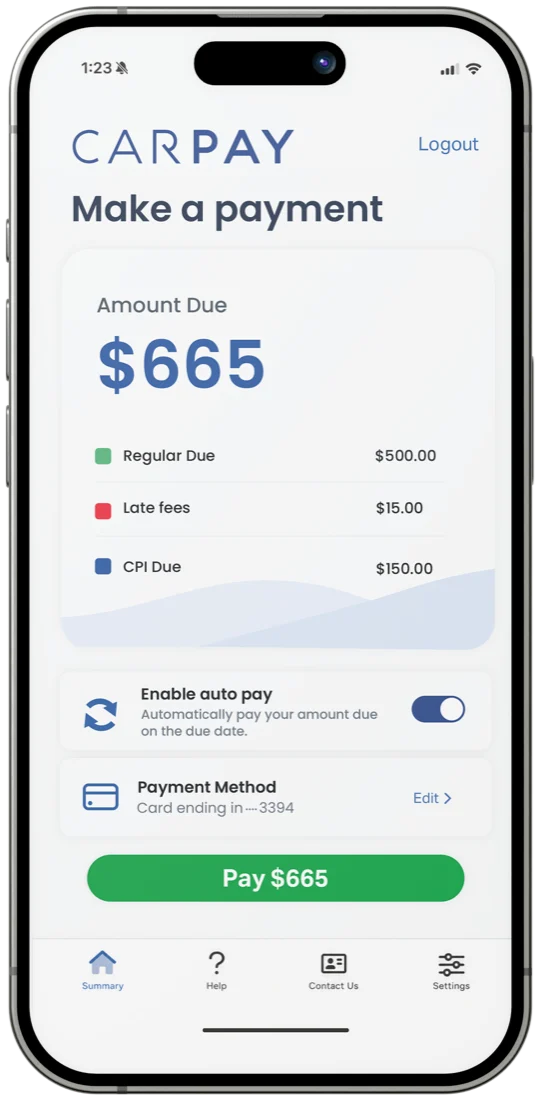
Carpay supports a native mobile app, SMS payment by replying PAY, a 24/7 inbound IVR line, and web payments. A registered app customer can see the balance, amount due, saved methods, payment history, and autopay without beginning every transaction as if this is the first time the dealership has ever encountered them. A customer who never wants to download the app does not have to.
How many easy paths have you created between “I need to pay my car note” and “paid”?
Text to pay is one very good answer. It is not the only answer.
Integrations
“We integrate with your DMS” is the beginning of the conversation
Both companies talk about integrations. Fine. A serious BHPH platform should. There are more useful questions.
Carpay was designed around the DMS remaining the dealer’s system of record while Carpay handles the servicing, payments, and communication around it.
Lots of software “integrates.” That word has been stretched over the years to cover everything from a real-time connection to two systems exchanging a CSV file occasionally and wishing one another the best.
The logo on the integrations page is not the product. The workflow is the product.
Pricing
What about pricing?
If you have proposals from each company, normalize them against your actual portfolio. Compare the monthly platform cost, dealer cost per transaction, borrower fees, who keeps those fees, cash-payment costs, implementation or integration charges, minimums, recurring fees, and the actual frequency at which your customers make payments.
That last part matters. Two hundred monthly-pay accounts and two hundred weekly-pay accounts do not create the same payment economics. A fee that looks harmless once can become considerably more ambitious after it has made 52 trips through the same account.
How to evaluate
The honest way to compare Carpay and BlytzPay
Do not spend the demo comparing feature menus. Give both companies the same difficult real-world accounts and make them work through them: the customer who is three days late, the one whose autopay failed last night, the weekly payer, the changed payment arrangement, the cash payer, the customer calling after hours, and the account that has moved far enough into delinquency that you’re considering recovery.
Watch what the customer has to do, what your employee has to do, what happens automatically, what makes it back to the DMS, and what still needs somebody in the office.
Then get specific. Ask whether the integration for your DMS is live now. Ask what happens during onboarding. Ask what your collector sees Monday morning. Ask which accounts the system thinks need attention and why. Ask what happens when the customer does not behave like the clean little account in the demo, because they almost never have the courtesy to do so.
And when the demo is over, open three tabs.
Put Blytz’s Auto Finance page in the first and its Property Management page in the second. See how easily the product story moves between the two. Then open Carpay’s About page. It starts with four words:
Blytz found a market where text to pay could solve a problem. Carpay started with the problem.
If you are the dealer living with that problem every day, we think that difference matters quite a lot.
Put it to the test
Bring us your hardest accounts.
We will work them in the demo — weekly payers, failed autopays, cash walk-ins and all.