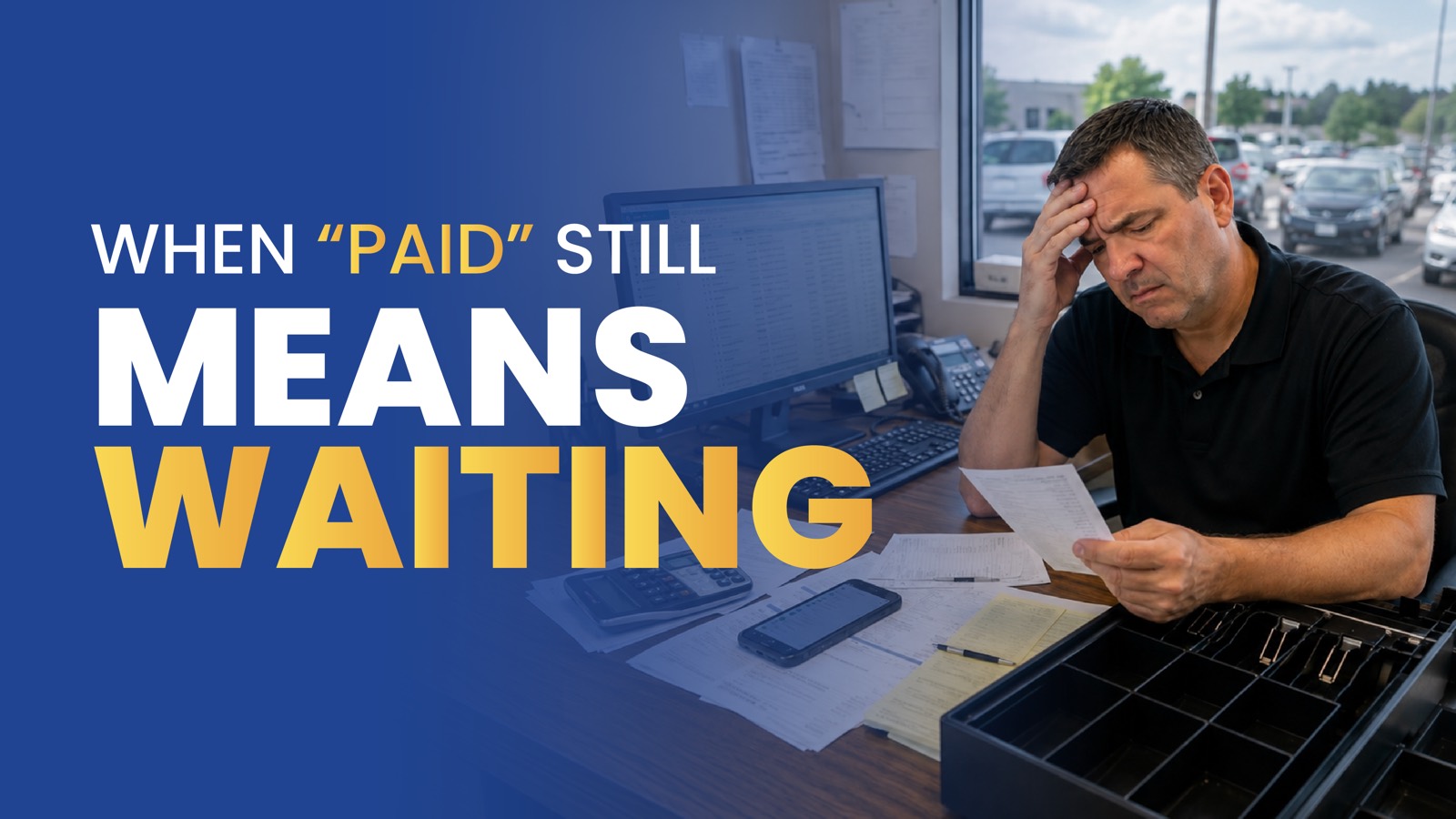
You got the customer to pay. That is usually the hardest part.
Maybe it was a regular weekly payment. Maybe you spent three days calling and texting. Maybe somebody finally put a $750 down payment on a card so you could finish the deal and move the car.
The payment goes through. Your system says approved.
So when does the money actually hit your bank account?
We talk to a lot of dealers, and funding that takes two to three business days is a frustration we’ve heard about more than once. That is the kind of thing that sounds vaguely reasonable on a merchant services application and looks absurd when you put it on a calendar.

Business days are doing a lot of work in that sentence
Take a payment on Monday. If everything starts counting immediately, two business days gets you to Wednesday. Three gets you to Thursday.
Now take the same payment on Friday. Saturday and Sunday do not count, so two business days can mean Tuesday and three can mean Wednesday.
Add a Monday bank holiday and suddenly a payment you collected Friday may not be available until Thursday. That is almost a week between getting paid and actually having the money.
Nothing went wrong. Nobody missed a payment. The customer already paid you.

The distance between your card terminal and your bank account is apparently the Oregon Trail.
The cutoff matters too
There is another detail that can change the answer: what counts as day one?
Processors have a daily cutoff time for transactions or batches. If the cutoff is 4:00 PM and you take a payment at 4:15, does that transaction count as Monday activity or Tuesday activity? That one detail can add another full business day.
It is why “two-day funding” does not always mean what a dealer assumes it means.
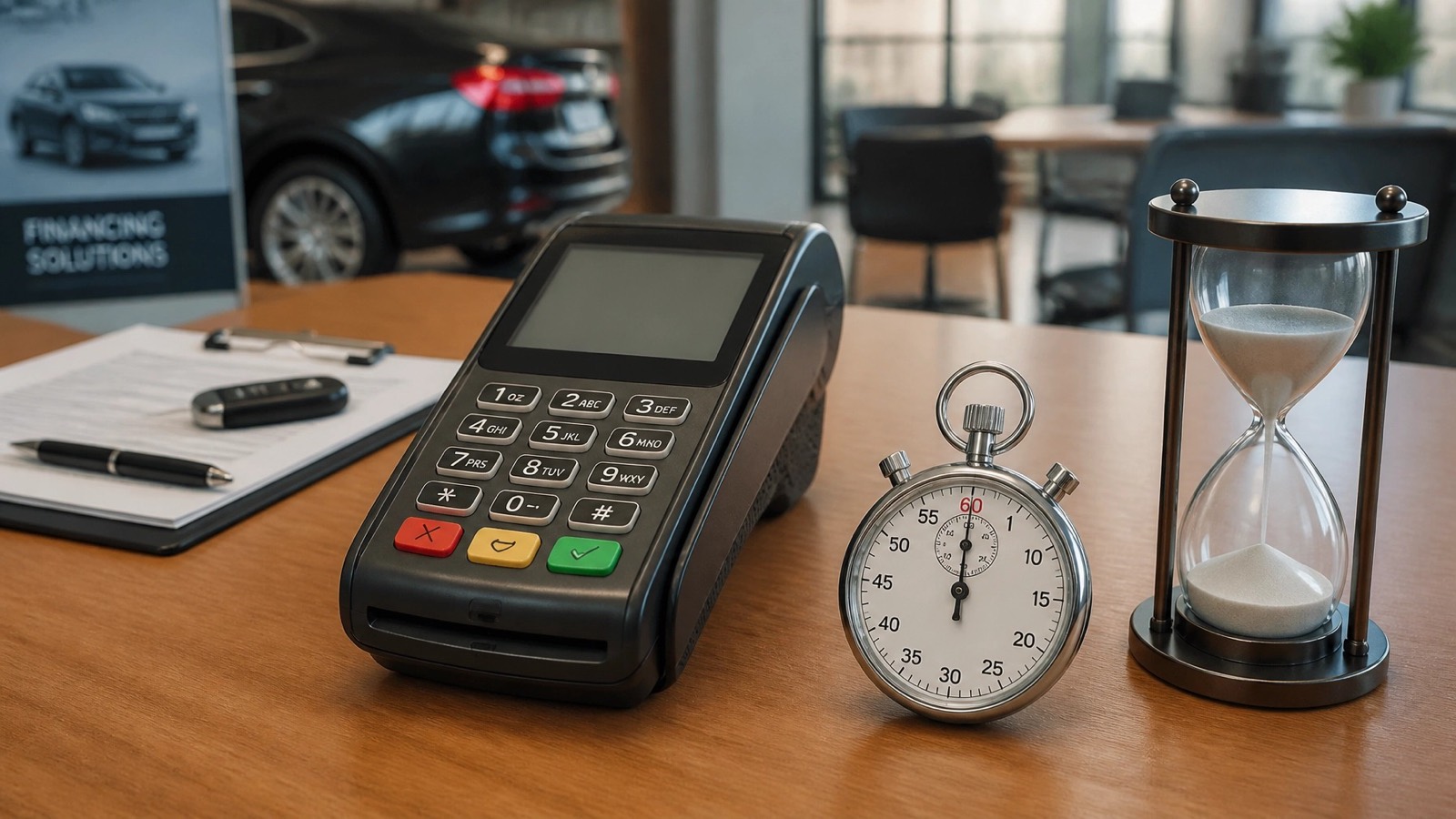
Ask your processor
- What is your daily funding cutoff?
- If I take a payment after that cutoff, when does the funding clock start?
Those two answers will tell you considerably more than the phrase printed on a rate sheet.
Now multiply it across the dealership
One delayed payment is annoying. A dealership’s entire card volume is a cash-flow issue.
Say you collect $15,000 per day in credit and debit card payments. Three days of deposits in transit is $45,000 that customers have already paid you but that you cannot use yet.
The good news is that the money exists. The less useful news is that you cannot spend it.

That is money that could be going toward inventory, repairs, payroll, floorplan, bills, or the next car you want to buy.
Processing cost is only part of processing
Dealers understandably spend a lot of time comparing processing rates, and they should. A few tenths of a percent across enough volume becomes real money.
But rate is not the only variable. Funding speed, cutoff times, deposit reliability, and knowing when a Friday afternoon payment will actually be available all affect what it is like to use a processor day to day.
A processor can save you four basis points and then spend three days sitting on $45,000 of your money.
Are we winning yet?
Carpay offers next-business-day funding
With Carpay credit card processing, payments processed before our 4:00 PM cutoff are funded the next business day. Collect it today. Have it in your account the next business day.
We are aware this is not a revolutionary concept, but it felt worth mentioning.

For dealerships that need even faster access to their money, we can also offer expedited same-day funding for an additional fee.
Not every dealership needs that. But every dealership should know how long it is waiting for money it has already collected.
The cutoff, the funding clock and what it does to cash flow are all spelled out on the dealer page.
Check yours
You do not need to take anybody’s word for it. Pull a few recent card transactions or batches and compare when they were processed with when the corresponding deposits actually became available in your bank account.
- Try a Monday.
- Try a Friday.
- Try one that landed near a holiday.
Then ask your processor what the cutoff is and exactly when its funding clock starts. You may discover that “two to three business days” looks a lot longer on a bank statement than it does on a rate sheet.
You worked hard enough to collect the money. You should know when you actually get it.
That tells you how long you wait. Your processing statement answers the other half — what the waiting is costing you on top of the fees. Run it through the rate calculator and you will have both numbers in one sitting.

About the author
Matt Darling, VP of Revenue at Carpay
With a background in scaling high-growth technology companies, Matt focuses on the economic mechanics of the BHPH industry and how dealers recover margin without making collections harder than they need to be.